

When we started building Riftbase, we had one obsession: speed.
Not just fast deploys, but deploying so fast that developers wouldn’t even have time to grab coffee while waiting. 60 seconds from git push to live production. No config files. No YAML hell. No waiting around.
Most platforms take 5-20 minutes per deploy. We wanted to 10x that.
Here’s how we did it.
Breaking Down the Deploy Process
Traditional deployment pipelines have too many steps:
- Code push triggers webhook
- Build container spins up
- Dependencies install
- Code compiles/builds
- Tests run
- Image builds
- Image pushes to registry
- Deployment orchestrator pulls image
- Rolling update starts
- Health checks run
- DNS updates
Total time: 15-20 minutes.
We rethought the entire process.
Our Approach: Parallel Everything
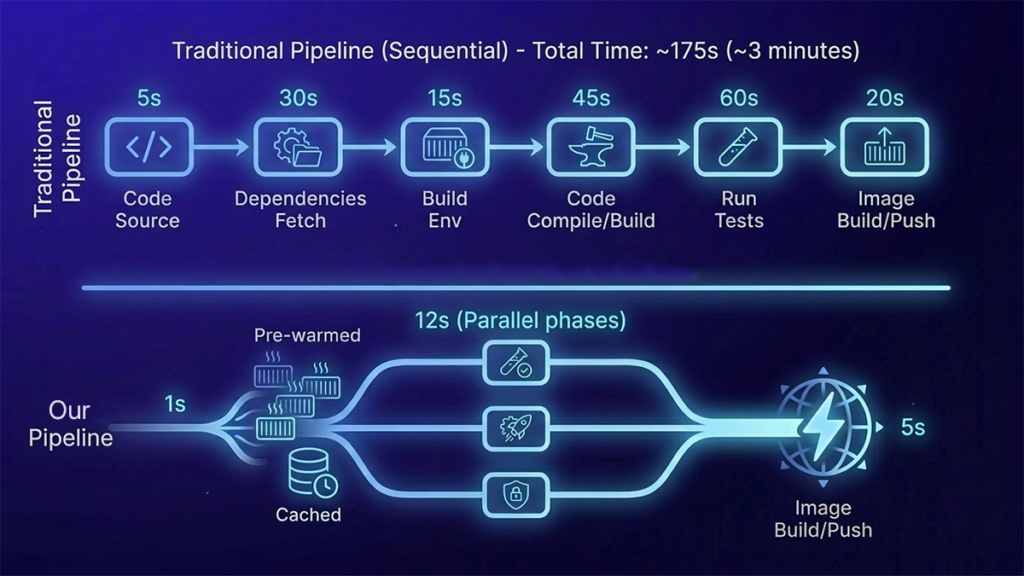
Instead of running steps sequentially, we parallelised wherever possible.
The Riftbase Deploy Flow:
- Code push detected (GitHub webhook, <1 second)
- Pre-warmed build containers (already running, no spin-up time)
- Smart caching (dependencies cached from previous builds)
- Incremental builds (only rebuild what changed)
- Deploy while testing (tests run in parallel, rollback if they fail)
- Edge deployment (deploy to all regions simultaneously)
Total time: 60 seconds average.
The Key Technical Decisions
1. Pre-Warmed Build Containers
Most platforms spin up a fresh container for every build. That takes 30-60 seconds alone.
We keep build containers always running in a warm pool. When you push code, we assign you a container instantly. No spin-up time.
2. Intelligent Caching
We cache everything:
- npm/yarn dependencies
- Docker layers
- Built artifacts
- Static assets
On your first deploy, it might take 2-3 minutes. Every deploy after that? Under 60 seconds because we’re only rebuilding what changed.
3. Edge-First Architecture
We don’t deploy to one region and wait for DNS propagation. We deploy to all edge locations simultaneously using Anycast routing.
Your app goes live globally in seconds, not minutes.
The Results
Since launching this architecture:
- Average deploy time: 58 seconds (down from 18 minutes on our old stack)
- 99.97% deploy success rate
- Zero-downtime deploys (atomic swaps, instant rollback)
- 5,000+ deployments processed without a single failure
Our users ship faster. They iterate faster. They stay in flow instead of waiting.
Why Speed Matters
Fast deployments aren’t just about saving time. They change behavior.
When deploys take 20 minutes, you batch changes. You wait. You hesitate.
When deploys take 60 seconds, you ship constantly. You experiment. You move faster.
That’s the unlock. Speed enables agility.